
Furnace Not Heating or Blowing Cold Air? Causes and Fixes
When a furnace stops heating, it's almost always one of a few things: the thermostat or power, a clogged filter, a worn ignitor or dirty flame sensor, a failing inducer motor, the control board, or the blower. Start with the checks below. Most need no tools.
By the Nur HVAC repair team · Updated November 9, 2026 · 10 min read

What is your furnace doing?
Pick the option that matches. You'll see what's safe to check on your own, what it usually turns out to be, and when to stop and call.
What is your furnace doing right now?
Fan runs, air is cold
Check yourself first
- Thermostat is on Heat and the fan is on Auto, not On.
- The gas shutoff next to the furnace is open: handle parallel to the pipe.
- Restart once: switch the furnace off at its wall switch, count to 30, switch it back on.
What we usually find
The burners aren't lighting, so only the fan runs. Most often a cracked ignitor or a dirty flame sensor.
Read more about this part ↓When to call
If the air is still cold 10 minutes after the restart.
Clicks or hums, then gives up
Check yourself first
- Look through the little window on the furnace door and count any blinking light.
- Make sure the filter isn't clogged.
- On a high-efficiency furnace (white plastic pipes), check that the drain tube isn't kinked or full of water.
What we usually find
The inducer motor or its pressure switch. The furnace won't light unless the inducer proves it's moving exhaust out.
Read more about this part ↓When to call
Now. Restarting it again and again won't revive a failing motor.
Nothing happens at all
Check yourself first
- New batteries in the thermostat, and the screen is on.
- The breaker for the furnace is on.
- The switch near the furnace (it looks like a light switch) is on.
- The front panel is pushed in all the way. A safety switch behind it cuts power when it's loose.
What we usually find
Power or the thermostat. Dead batteries, a tripped breaker, or thermostat wires that came loose.
Read more about this part ↓When to call
If all four checks pass and the furnace is still silent.
Heats a few minutes, then stops
Check yourself first
- Replace the filter if it's grey or you can't see light through it.
- Open every supply vent and clear anything off the return grille.
What we usually find
It's overheating and the limit switch shuts the burners off. A clogged filter is the usual reason, a dirty flame sensor is next.
Read more about this part ↓When to call
If it keeps short cycling with a clean filter.
A light blinks in a pattern
Check yourself first
- Count the blinks, then match them to the code chart on the inside of the furnace door.
- Take a phone photo of the chart and the light.
What we usually find
The control board is telling you what it sees: a pressure switch, flame or limit problem. Sometimes the board itself has failed.
Read more about this part ↓When to call
With the code ready. It shortens the visit.
Old furnace, pilot light is out
Check yourself first
- Follow the relight steps on the furnace label exactly.
- If it won't stay lit after one try, stop.
What we usually find
A worn thermocouple, a dirty pilot or a draft. Furnaces with a standing pilot are usually 30 years old or more.
Read more about this part ↓When to call
If the pilot won't stay lit. PG&E can also relight a pilot and check gas appliances.
Heat pump blows cool air
Check yourself first
- Wait 10 to 15 minutes. On cold, damp mornings it runs a defrost cycle.
- Check that the outdoor unit runs and isn't buried in ice.
- Don't leave it on Emergency Heat for days.
What we usually find
Often normal defrost. If not, a failed start part or fan motor outdoors, or a refrigerant leak.
Read more about this part ↓When to call
If cool air lasts longer than 15 minutes, or the outdoor unit stopped.
Some rooms warm, others cold
Check yourself first
- Open every vent and check the filter.
- On a zoned system, check each zone thermostat.
What we usually find
A duct that came apart in the attic or crawlspace, a crushed flex duct, or a zone damper stuck closed.
When to call
If one area stays cold with everything open.
Why is my furnace not heating? 7 checks before you call
A good share of no-heat calls end with one of these. They take about five minutes and none of them involve opening the burner area.
- 1
Thermostat mode and fan
Set it to Heat, a few degrees above the room temperature. Set the fan to Auto. On On, the fan keeps blowing between heating cycles and the air feels cold even when nothing is broken.
- 2
Thermostat power
If the screen is blank or dim, replace the batteries. Some thermostats run on furnace power: a blank screen there points back to the furnace.
- 3
Breaker and furnace switch
Check the breaker labeled furnace or FAU. Then find the switch on the wall or the furnace itself. It looks like a light switch and is easy to flip by accident.
- 4
Front panel
The door over the blower has a safety switch behind it. If the panel isn't pushed all the way in, the furnace won't run at all.
- 5
Filter
Pull it out and hold it up to a light. If you can't see light through it, replace it. A choked filter is the most common reason a furnace overheats and shuts itself off.
- 6
Gas shutoff
On the gas pipe next to the furnace there's a small valve, often with a yellow handle (number 7 on the photo above). Handle parallel to the pipe means open. Crossways means closed. Don't force it.
- 7
Vents and drain
Open every supply vent and keep the return grille clear. On high-efficiency furnaces with white plastic pipes, a kinked or clogged condensate drain trips a float switch and stops heating.
Furnace blowing cold air or not starting: the usual causes
A gas furnace starts in a fixed order: the thermostat calls for heat, the inducer motor clears the exhaust path, a pressure switch confirms it, the ignitor heats up, the gas valve opens, the flame sensor confirms the flame, and only then the blower sends warm air to the house. When one step fails, everything after it stops. The photos below are parts our technicians replaced on Bay Area calls.

Worn or cracked hot surface ignitor
The ignitor is a thin ceramic element that glows orange-hot and lights the gas. It heats up and cools down thousands of times a season, and eventually it cracks. A cracked ignitor often fails on the first cold morning after a long mild stretch, when the furnace hasn't run for months.
What you notice: the inducer starts, you hear a few clicks, but no flame. The furnace tries two or three times, then locks out. If the fan comes on anyway, the air is cold.
You can: watch through the window: no orange glow within about a minute points here.
Call us: a replacement ignitor has to match your furnace, and it breaks if touched with bare fingers.
Dirty flame sensor
Right next to the burners sits a small metal rod that proves the flame is there. Over the years it gets a thin coating and stops reading the flame. The furnace then shuts the gas off as a safety measure, a few seconds after lighting.
What you notice: the burners light, run for a few seconds, and go out. This repeats until the furnace locks out.
You can: note how long the flame stays on before it goes out.
Call us: cleaning it means removing it from the burner area, which we handle during a visit or a tune-up.
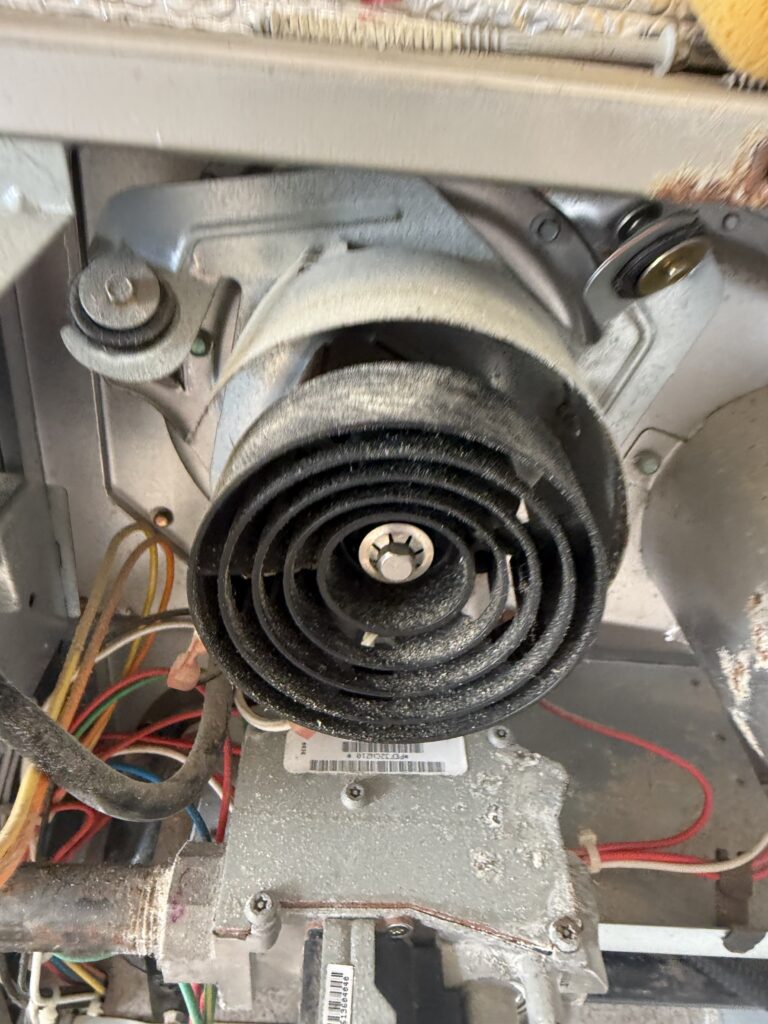
Inducer motor and pressure switch
The inducer is the small fan near the top of the furnace that pushes exhaust out through the flue before the burners may light. A pressure switch, connected to it with a thin hose, confirms it's working. Worn bearings, a cracked hose or a blocked vent stop the sequence right here. It's one of the parts we replace most often.
What you notice: humming or grinding at startup, then nothing. Often a blinking code that points at the pressure switch. The one in the photo was replaced during a maintenance visit in San Francisco because it was getting loud, before it failed.
You can: listen at startup and check that the outdoor exhaust pipe isn't blocked.
Call us: a failing motor won't recover. Repeated restarts only add wear.

Overheating: clogged filter and the limit switch
The limit switch shuts the burners off when the furnace gets too hot inside. The usual reason is airflow: a filter like the one in the photo, closed vents, or a blocked return. Bay Area smoke seasons fill filters faster than the package says.
What you notice: it heats for a few minutes, stops, the fan keeps running, then it starts again. The house never quite gets warm.
You can: replace the filter and open every vent. Change filters every 1 to 3 months, more often in smoke season.
Call us: if it still short cycles with a clean filter. The limit switch or the blower may be failing.

Control board
The control board runs the whole startup sequence and watches every safety switch. Power surges, age and moisture take them out. A failed board can make a furnace do nothing at all, run the fan non-stop, or show codes that don't match what's happening.
What you notice: no response to the thermostat even with power on, or a code that keeps changing.
You can: read and photograph the blinking code before you call.
Call us: boards are tested before they're replaced. Swapping one on a guess is expensive.
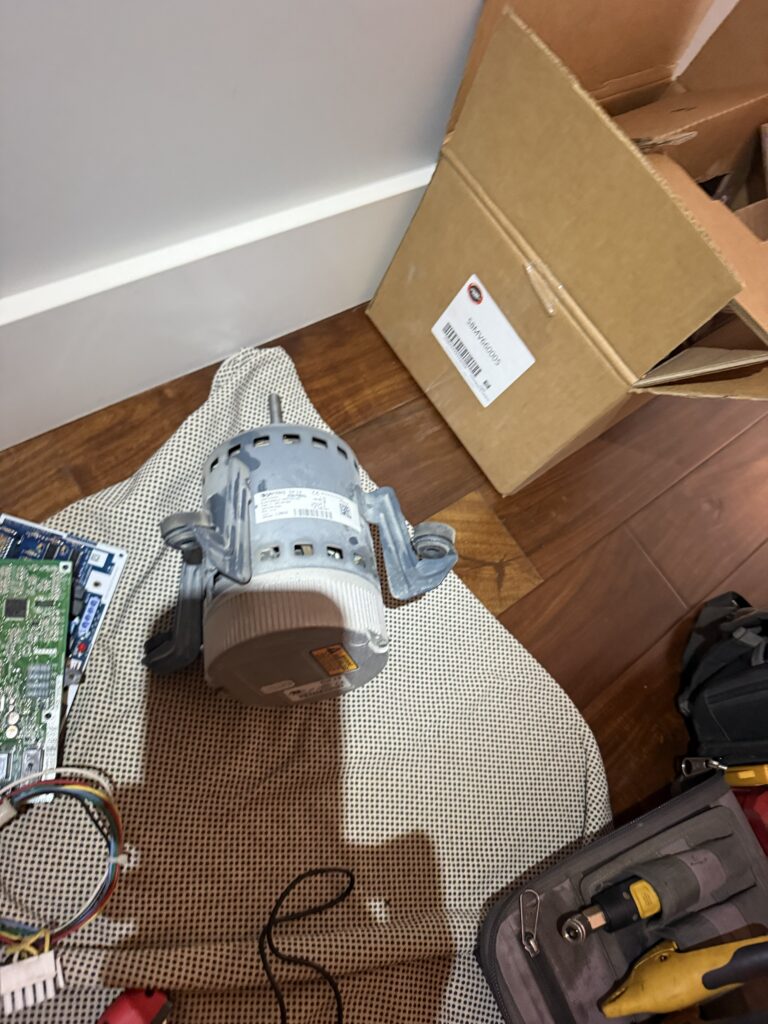
Blower motor and capacitor
The blower moves warm air through the ducts. When the motor or its start capacitor weakens, the furnace heats up but can't push the heat out, so it overheats and shuts down. The motor in the photo came out of a Carrier Infinity in Palo Alto.
What you notice: burners light but little air comes out of the vents, a loud hum from the cabinet, or a burning smell.
You can: check that the filter and vents are open, since airflow problems look similar.
Call us: if airflow is weak with a clean filter, or you hear humming without the fan turning.

Thermostat and wiring
Thin low-voltage wires connect the thermostat to the furnace board. A loose or broken wire means the furnace never hears the call for heat. On one San Jose call the furnace was fine: the wires had simply come off. No parts, just a careful look at the connections.
What you notice: the thermostat says heating, but the furnace stays silent.
You can: new batteries, and check that the thermostat sits firmly on its wall plate.
Call us: if the furnace doesn't respond with power on and fresh batteries.
Gas supply, gas valve and standing pilots
If other gas appliances work and the shutoff by the furnace is open, the gas valve inside the furnace may not be opening. On older furnaces with a standing pilot light, the pilot can go out because of a draft or a worn thermocouple.
What you notice: everything starts, the ignitor glows, but there's no flame. Or on an old furnace, no pilot flame at all.
You can: check the shutoff handle position and relight a pilot exactly as the furnace label says, once.
Call us: for anything inside the gas valve. PG&E can also relight a pilot and check gas appliances.
Furnace blinking light codes
Most furnaces made in the last 25 years have a small LED on the control board, visible through a window in the lower door. A steady light or a slow, even blink usually means normal standby. A pattern of short and long flashes is a fault code.
Codes differ by brand and even by model, so always use the chart printed on the inside of your furnace door. Most codes fall into a few groups: pressure switch or inducer, flame sensing, limit switch or overheating, ignition lockout after several failed tries, and wrong polarity or wiring.
Before you call, take a photo of the blinking light and the chart. Switching the power off clears the code, so read it first.
Heat pump blowing cold air?

A heat pump that blows cool air for a few minutes on a cold, foggy morning is usually defrosting. Moist Bay Area air puts frost on the outdoor coil when it's in the 30s and low 40s, and the system reverses for 5 to 15 minutes to melt it. Steam from the outdoor unit during defrost is normal.
Heat pump air also feels cooler than furnace air. It comes out of the vents around 90 degrees, while a gas furnace pushes air at 120 or more. That's why it feels lukewarm on your hand even when it's heating the house fine.
Not normal: cool air for more than 15 minutes, an outdoor unit that doesn't spin, ice that stays on the coil, or a system that only keeps up on Emergency Heat. On heat pump calls we most often find failed start parts or a fan motor in the outdoor unit, or a refrigerant leak at the line connections. Adding refrigerant without fixing the leak only buys a few weeks. More on heat pump repair.
Why Bay Area furnaces fail the way they do
Long idle summers
Furnaces here sit for months. Dust settles on the flame sensor and burners, and weak ignitors crack on the first cold night of the season. That's why no-heat calls spike with the first cold snap.
Attics, crawlspaces and garages
Many Peninsula and South Bay homes from the 1940s to 70s have the furnace in the attic, a low crawlspace or a garage closet. Dust, rodents and moisture there are hard on wiring and motors.
Smoke season
Wildfire smoke loads filters in days, not months. A clogged filter in September is a common reason for an overheating furnace in November.
Coastal air
Near the bay and the coast, damp salty air corrodes outdoor heat pump parts and connections faster.
Repair or replace?
Most no-heat calls end with a repair: an ignitor, an inducer motor or a control board is usually enough to get a furnace running again. Replacement starts to make sense around 15 to 20 years of age, after a cracked heat exchanger, or when one repair costs a large share of a new system. We put both options in writing.
If you replace, plan ahead: Bay Area air district rules phase out sales of new gas furnaces starting in 2029. A heat pump replaces the furnace and AC in one system, and a dual-fuel setup keeps a furnace as backup. Electricity providers including WestLight Energy (formerly Peninsula Clean Energy), Silicon Valley Clean Energy and City of Palo Alto Utilities offer rebates for switching. See furnace replacement.
What a no-heat visit looks like
- 1
You call or book
Phone +1 (650) 542-8555, 8am - 8pm every day, or book online any time.
- 2
We test before we touch
The technician reads the codes, checks gas pressure, voltages and every safety switch, and finds the actual cause.
- 3
You get the price first
You hear what failed and the price before any work. The $85 diagnostic is credited toward the repair if you go ahead.
Furnace not heating: questions
Why is my heater not working but the fan is running?
The fan runs but the burners aren't lighting, so you feel room-temperature air. On our calls that's most often a cracked ignitor or a dirty flame sensor, sometimes a closed gas shutoff. Also check the thermostat fan setting: on On instead of Auto, the fan blows between heating cycles.
How do I know if my furnace ignitor is bad?
Watch through the window when the furnace starts. After the inducer starts, the ignitor should glow bright orange within about a minute. If it never glows, or you can see a crack in it, the ignitor is the likely cause.
Why does my furnace turn on and then shut off?
Usually it's overheating because of a clogged filter or blocked vents, and the limit switch shuts it down. A dirty flame sensor causes a similar pattern: the burners light for a few seconds and go out.
Should I turn off my furnace if it's blowing cold air?
Set the thermostat to Off so the fan doesn't keep running, and try one restart. If you smell gas or hear loud banging, switch it off and call.
Can I reset my furnace myself?
Yes, once: switch the furnace off at its wall switch, wait 30 seconds, switch it on. If it fails again, stop. Repeated resets can hide a safety shutdown.
Is it normal for a heat pump to blow cold air in winter?
For a few minutes during defrost, yes. Heat pump air also feels cooler than furnace air because it comes out around 90 degrees instead of 120 or more. Cool air for longer than 15 minutes is not normal.
How old is too old to repair a furnace?
Around 15 to 20 years, or when one repair costs a large share of a new system, replacement usually makes more sense. We put both options in writing.
I smell gas near the furnace. What should I do?
Don't touch switches or the thermostat. Leave the house and call PG&E or 911 from outside. Call us once the gas side is safe.
Related: Furnace repair · Heat pump repair · HVAC repair · San Mateo · San Francisco · Palo Alto · San Jose